
October 16, 2026
Lyophilized Peptide Storage Temperature Rules
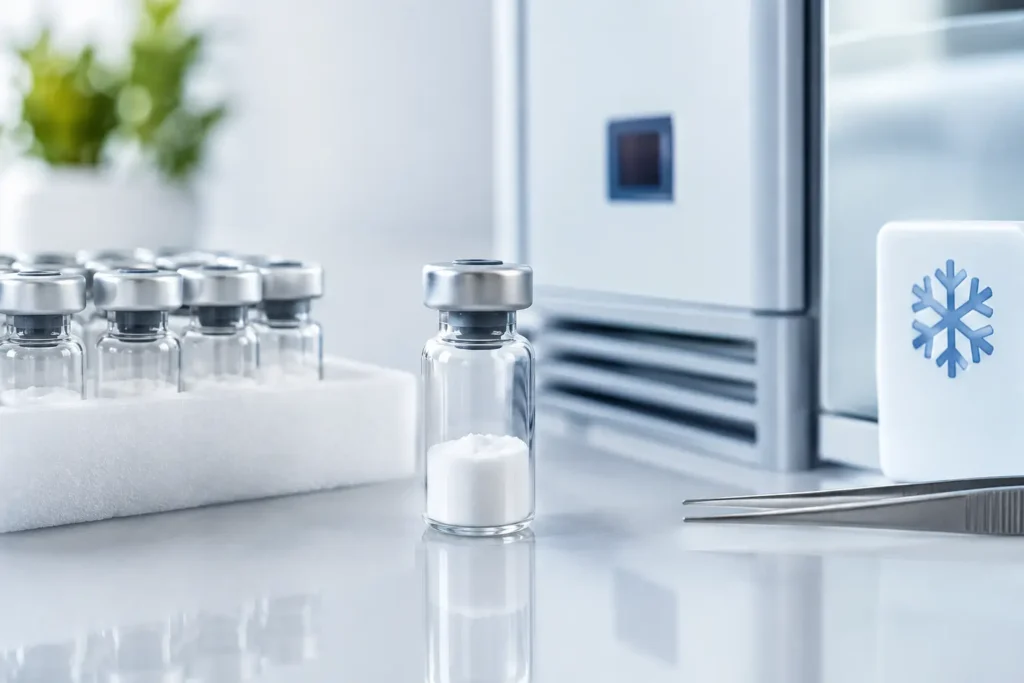
A peptide can leave a controlled lyophilization process dry, purified, identity-confirmed, and suitable for release, then lose practical research value through casual storage. Lyophilized peptide storage temperature is therefore not a warehouse detail. It is part of material control, alongside lot identity, purity documentation, container integrity, and handling history.
For qualified researchers, the correct answer is rarely just “keep it cold.” Temperature must be selected with the material’s expected storage duration, sequence-specific liability, formulation, packaging, and planned use in mind. A documented storage condition is more useful than a generic rule because it gives the laboratory a handling standard that can be applied consistently across personnel and studies.
Why Lyophilized Material Still Requires Control
Lyophilization removes water from the peptide preparation, substantially reducing many solution-phase degradation pathways. It does not make every peptide chemically inert. Residual moisture, oxygen exposure, repeated warming, light, and poor closure can still affect a dry material over time.
The relevant risks depend on the peptide. Sequences containing oxidation-prone residues may be more sensitive to oxygen exposure. Other structures may be vulnerable to deamidation, aggregation, hydrolysis after moisture uptake, or physical changes that complicate accurate reconstitution. Counterions, residual solvent, vial headspace, and the quality of the stopper or seal can also influence real-world stability.
That is why “lyophilized” should describe the physical state of the material, not serve as a blanket stability claim. A cold storage instruction should be treated as a controlled condition tied to a specific lot and packaging configuration.
Recommended Lyophilized Peptide Storage Temperature
For many research-grade lyophilized peptides, storage at -20°C is an appropriate baseline for preserving dry material intended for medium- or longer-term retention. It limits thermal stress while remaining practical for controlled laboratory inventory. Wolf Peptides maintains released lyophilized material under cold storage at -20°C as part of its handling workflow.
However, -20°C is not automatically the right answer for every condition. A manufacturer’s labeled instructions and lot-specific documentation take precedence. If a material has been supplied with a defined storage range, use that range in the laboratory record rather than substituting a general convention.
For short operational intervals, a refrigerated condition may be acceptable for some materials when the container remains sealed and dry. Room-temperature exposure may be tolerable during brief transit or setup, but it should not be treated as default storage without supporting stability information. The difference between a short, documented excursion and weeks on an open bench is substantial.
Lower temperatures can be useful for extended retention or especially sensitive materials, but colder is not always simpler. Freezers introduce handling risks when vials are moved repeatedly between cold storage and ambient laboratory conditions. Condensation can form on a cold container, and moisture becomes a concern if the vial is opened before it has equilibrated.
Temperature Is Only One Part of Storage Control
A setpoint on a freezer display does not establish a controlled storage condition by itself. The practical objective is to keep the vial dry, closed, protected from unnecessary light, and exposed to as few temperature transitions as the workflow allows.
A sound storage system addresses four connected controls:
- Temperature consistency: Use a monitored freezer or refrigerator appropriate to the labeled condition. Avoid placing critical material in door shelves or other locations subject to frequent fluctuation.
- Moisture exclusion: Retain peptides in tightly closed primary containers. If secondary containment includes desiccant, keep it intact until use and replace it when the storage system requires it.
- Light protection: Store light-sensitive or uncertain materials in opaque secondary packaging or protected freezer locations rather than under continuous room light.
- Access discipline: Divide inventory into working and reserve units when feasible. This reduces the number of times the long-term stock experiences handling and temperature change.
These measures are not administrative excess. They reduce variables that can otherwise become indistinguishable from an experimental effect.
Avoid Repeated Warm-Up and Cool-Down Cycles
Repeated temperature cycling is often a larger operational problem than a single, brief temperature excursion. Each removal from cold storage creates an opportunity for the container to warm, for atmospheric moisture to contact the closure, and for the material to be returned under less-than-ideal conditions.
When a vial must be opened, allow the sealed container to equilibrate to room temperature before opening it. This simple step helps reduce condensation on or near the closure. After removing the required amount, close the vial promptly and return it to the specified storage condition.
For studies requiring repeated access, aliquoting at an appropriate stage of the workflow can improve consistency. The correct point for aliquoting depends on the validated procedure and the material’s intended preparation. Some laboratories prefer to maintain the lyophilized vial intact until a defined reconstitution event; others prepare controlled solution aliquots for a short experimental window. These are different storage states and should not share the same assumed stability profile.
Once reconstituted, a peptide solution generally requires more conservative handling than the original lyophilized material. Solvent composition, pH, concentration, container surface, microbial control, and freeze-thaw exposure can all matter. Do not extrapolate dry-powder storage expectations to a solution without method-specific support.
Build Lot Traceability Into the Storage Record
A freezer location is not enough to support reproducibility. The laboratory should be able to connect the vial in storage to its supplier, lot number, certificate of analysis, receipt date, storage condition, and handling history.
At minimum, the primary or secondary label should preserve the material name, lot number, concentration or mass, receipt date, and required storage condition. A laboratory inventory record can also document freezer location, the date a vial was first opened, and any observed temperature excursion. If material is transferred into a different vial or aliquoted, the new container should retain traceability to the original lot.
This matters when results need to be investigated months later. A purity figure without a lot number is only a claim. A result tied to a specific, independently tested lot and a documented storage history gives the research team something concrete to evaluate.
Every released lot should be assessed against its own certificate of analysis and release information. Independent identity and purity testing provides evidence of what was released. Proper storage preserves the laboratory’s ability to use that evidence meaningfully after receipt.
Responding to a Temperature Excursion
Not every excursion requires automatic disposal, but none should be ignored. The appropriate response depends on the labeled storage condition, duration, temperature reached, whether the vial remained sealed, and the peptide’s known sensitivity.
First, isolate the affected material from routine use and record the event. Confirm the actual conditions from the monitoring system rather than relying on assumptions. Inspect the container for compromised closure, moisture, discoloration, or unexpected physical change, while recognizing that normal appearance does not establish chemical integrity.
Next, compare the event with available supplier guidance and the study’s risk tolerance. For exploratory work, a documented, limited excursion may be manageable if the material remains clearly identified and the risk is acknowledged. For critical comparative, quantitative, or regulated-adjacent research, replacement or analytical confirmation may be the more defensible choice.
The key is to avoid quietly returning questionable material to inventory as if nothing occurred. Undocumented uncertainty has a way of appearing later as unexplained assay variation.
Storage Discipline Supports Better Experimental Decisions
Peptide quality does not end at release. It continues through shipping receipt, freezer placement, vial access, reconstitution, and recordkeeping. A properly stored lyophilized peptide gives researchers a better basis for interpreting results because fewer uncontrolled variables sit between the certificate and the experiment.
Use the labeled condition, keep the container dry and sealed, minimize cycling, and retain lot-level records. For research materials, that discipline is not separate from quality control. It is the final part of it.

1 comments