October 17, 2026
Cold Chain Peptide Shipping for Research Lots
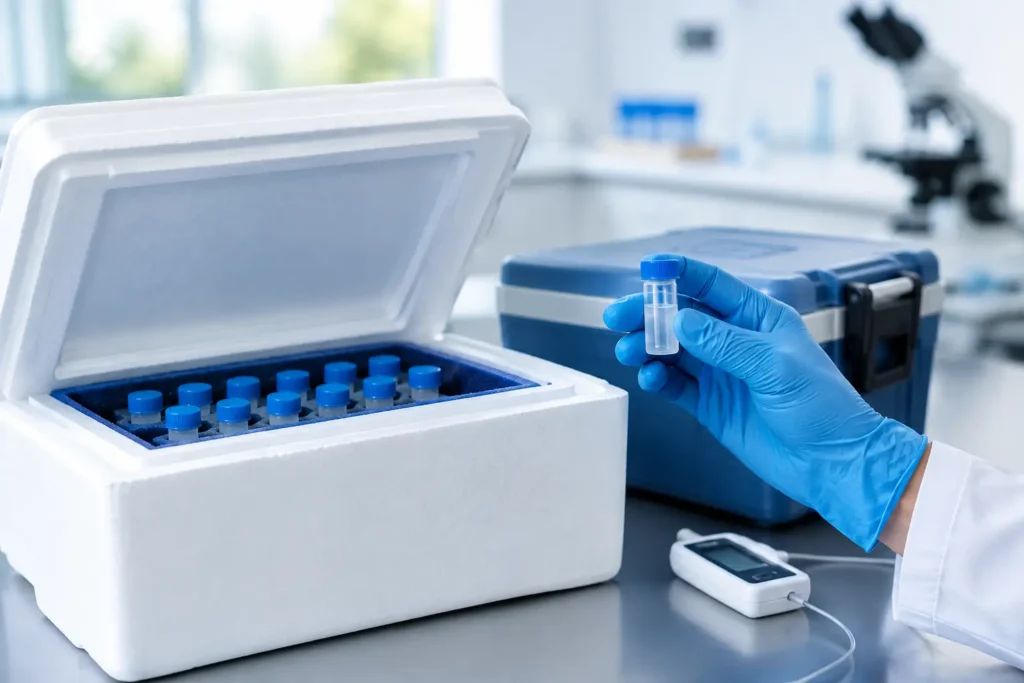
A peptide can leave a controlled -20°C storage environment with a valid certificate of analysis and still arrive as a difficult material to interpret if shipment handling is treated as an afterthought. Cold chain peptide shipping is not simply the use of an insulated box. For research materials, it is a documented control point between lot release and laboratory receipt, with direct implications for traceability, handling decisions, and experimental confidence.
For lyophilized peptides, the appropriate shipping configuration depends on the material, package format, expected transit time, seasonal conditions, and the handling limits established for that lot. A generic statement that an order ships “cold” does not answer the questions a laboratory needs answered: What was the storage condition before dispatch? How was the package prepared? What happens during a delay? How does the recipient assess the shipment on arrival?
What Cold Chain Peptide Shipping Must Control
Cold-chain handling begins before a shipping label is created. The relevant chain starts with released inventory held under its defined storage condition, then continues through picking, packing, carrier transfer, transit, and laboratory receipt. A break at any stage can complicate the interpretation of the material, even where the vial remains physically intact.
For a research supplier, the central objective is not to make a broad stability promise. It is to maintain defined handling conditions and provide a clear basis for the receiving laboratory to identify the exact material delivered. That means keeping the product label, lot number, quantity, and associated documentation connected throughout fulfillment.
At Wolf Peptides, released research materials are held in cold storage at -20°C after synthesis, purification, analytical testing, and certificate-backed release. Every lot is tested by an independent laboratory before it is released. Shipping should preserve that same discipline: the lot received must be the lot a researcher can verify against its certificate of analysis.
The shipment is part of the material record
A certificate of analysis documents the tested lot, not an abstract product name. The vial label and the order record must therefore allow the laboratory to match the delivered material to its lot-specific identity and purity data. This matters especially when a laboratory has multiple lots of the same peptide in inventory or is comparing results across experiments.
The shipping process should preserve legibility and separation. Labels should remain readable after cold-pack contact or condensation. Individual units should be protected from movement, and packaging should prevent a cold source from damaging vial labels or creating avoidable moisture exposure. These are basic details, but they are part of a controlled receipt process.
Temperature control is not a single setting
“Cold chain” can refer to refrigerated, frozen, or dry-ice-supported transportation. Those are not interchangeable conditions. The right approach depends on the material’s defined storage requirement and the expected shipping lane. A package designed for a short regional delivery may not be appropriate for a multi-day route, a weekend hold, or a period of extreme heat.
Lyophilized material often has different practical handling considerations than material in solution. The absence of bulk water can improve transport tolerance in some circumstances, but it does not remove the need for controlled storage, dry packaging, or documented lot management. Researchers should avoid assuming that a lyophilized peptide can be handled indefinitely at ambient conditions simply because it is dry.
How to Evaluate a Cold Chain Peptide Shipment
Receipt should be treated as a short laboratory control procedure rather than a routine unboxing step. The purpose is to document what arrived, assess obvious shipment issues, and move the material to its specified storage condition without unnecessary delay.
Start with the outer package. Look for evidence of damage, crushing, water intrusion, or an extended carrier delay. Then confirm that the internal packaging has kept the vial protected and that the product label remains legible. A cold pack that is no longer frozen is not, by itself, proof that the peptide is unsuitable. Its significance depends on the expected transit duration, pack design, seasonal conditions, and any available shipment documentation.
Next, verify the vial against the purchase record. Confirm the peptide name, labeled quantity, and lot number before the material enters inventory. Retrieve or retain the certificate of analysis associated with that lot. A purity figure without a lot number is a general claim. A purity figure tied to the vial’s lot number is something a researcher can check.
If a package appears compromised, document the condition before disposing of any shipping materials. Photographs of the exterior, internal configuration, labels, and carrier information create a useful record for supplier review. The appropriate next step may be straightforward, but it should be based on evidence rather than an assumption made after the material has been moved, opened, or reconstituted.
Build receipt controls into laboratory workflow
The most useful controls are usually simple and repeatable. Assign a receiving date, record the lot number, retain the COA, and place the vial promptly into the specified storage environment. If the laboratory uses a sample management system, the shipment record should connect the lot number to experimental use, aliquoting history, and any reconstitution record.
For higher-sensitivity work, laboratories may choose to record package condition, carrier transit time, and the receiving staff member. This is not necessary for every workflow, but it can be valuable when investigating an unexpected analytical result. The correct level of documentation depends on study design, material criticality, and the laboratory’s quality system.
Packaging Decisions Involve Real Trade-Offs
More cooling capacity is not automatically better. Excess cold source contact can create condensation risks, damage labels, or expose a package to temperatures that are not aligned with the product’s handling plan. Conversely, minimal packaging may be insufficient for a route with weather exposure or carrier variability.
The practical goal is a qualified package configuration matched to the shipment. That includes insulation, cold-source placement, absorbent or moisture-management materials where appropriate, vial protection, dispatch timing, and carrier service selection. A Friday shipment may be reasonable only when the delivery plan avoids an uncontrolled weekend hold. During periods of elevated heat or severe weather, the same route may require a different approach or a delayed dispatch.
Temperature monitoring can add useful evidence, particularly for longer or higher-risk routes, but a data logger is only useful when its placement, accuracy, activation, and review process are defined. A logger placed against a cold pack may report a temperature that does not represent the vial environment. A shipment record without a plan for exception review creates data without a decision process.
Documentation Is the Control That Travels Furthest
Carrier scans and insulated packaging are temporary. Lot documentation remains useful after the shipment is received, the vial is placed into storage, and the material is used months later. That is why cold-chain execution and certificate access should work together rather than as separate promises.
A defensible research-material workflow connects four records: the released lot, its independent analytical documentation, the fulfillment record, and the laboratory’s receiving record. Each record answers a different question. The COA supports the identity and purity claim for the released lot. The order and vial label identify what was delivered. The receiving record documents how the laboratory took custody of it.
This level of control is especially relevant when results need to be compared across lots, repeated by another researcher, or reviewed after an unexpected outcome. Shipping cannot replace analytical verification, and analytical verification cannot explain an undocumented delivery issue. Both are needed for an accountable supply chain.
Research-Only Handling Requires Clear Boundaries
Peptide materials supplied for laboratory investigation must remain within their stated research-use restrictions throughout ordering, receipt, storage, and use. They are not approved for human or veterinary use, diagnosis, treatment, or consumption. Cold-chain handling protects research material management; it does not change the intended-use limitation of the product.
Qualified researchers should also avoid converting storage guidance into performance claims. A defined storage condition supports controlled handling, but it does not eliminate the need for method-specific validation in a particular assay, matrix, reconstitution solvent, or experimental design. If a project requires a particular stability window after reconstitution, that question belongs in the laboratory’s own validation work.
The strongest shipment is one a receiving scientist can account for without filling gaps with assumptions: the vial is identifiable, the lot is verifiable, the package condition is documented, and the material is returned promptly to defined storage. That is the practical standard worth carrying from supplier release to the laboratory freezer.