October 20, 2026
Preparative HPLC Peptide Purification Explained
A crude peptide can show the expected molecular mass and still be unsuitable for controlled research use. Deletion sequences, incompletely deprotected material, oxidation products, epimers, protecting-group remnants, and closely related byproducts may sit beside the intended sequence in the crude mixture. Preparative HPLC peptide purification is the process used to physically separate that target material before a lot is evaluated for release.
For researchers, the relevant question is not whether a supplier states that purification occurred. It is whether the purification workflow, the post-purification analytical data, and the lot number establish what material was released. A reported purity value without a traceable lot and supporting identity data is only a general claim. A lot-specific certificate connects the stated result to the material in hand.
What preparative HPLC peptide purification does
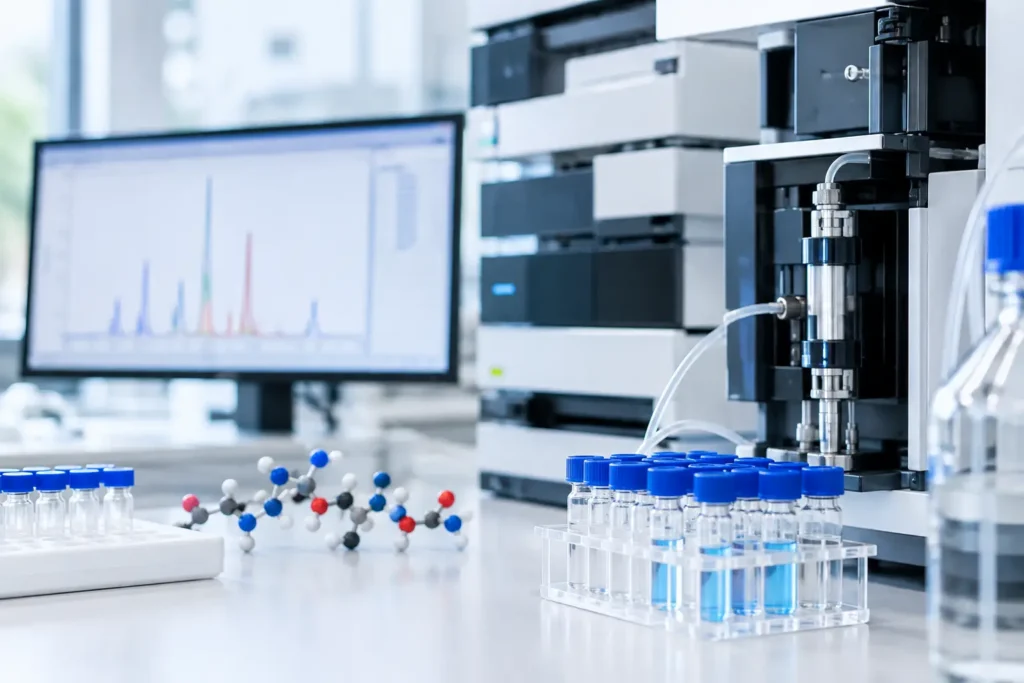
Preparative high-performance liquid chromatography is a scaled purification method, most often performed with reversed-phase media for synthetic peptides. The column is packed with a stationary phase, commonly C18 or another hydrophobic bonded phase. A liquid mobile phase carries the crude peptide mixture through that bed under pressure.
Peptide components partition differently between the stationary phase and the mobile phase. Differences in sequence, hydrophobicity, charge state, conformation, and modification state can change retention. By adjusting the organic-solvent composition over time, the system elutes components in distinct chromatographic peaks. The fraction corresponding to the intended peptide is collected, rather than treating the complete crude synthesis as a single material.
This is a separation step, not a substitute for characterization. Preparative chromatography can enrich and isolate a target fraction, but it does not independently prove sequence identity. That requires appropriate orthogonal assessment, commonly mass spectrometry alongside analytical HPLC. Purification and assay answer related but different questions.
Why peptide purification is rarely a one-setting process
A peptide’s behavior on a preparative column depends on more than its nominal molecular weight. Two sequences with similar masses may resolve cleanly or overlap substantially. A single residue deletion, an oxidation event, or an isomeric impurity may produce only a small change in retention. Some peptides also aggregate, adsorb strongly, or show poor solubility in a starting mobile phase.
Method development therefore begins with analytical scouting. A smaller-scale chromatographic run helps determine retention, peak shape, and the separation between the target and nearby impurities. The preparative method can then be selected with a deliberate gradient, column chemistry, flow rate, loading level, and collection window.
There is no universal gradient that produces a useful result for every peptide. A shallow gradient may improve resolution between closely eluting components, but it takes longer and lowers throughput. A steeper gradient can be efficient for well-separated material but may merge a target peak with a related impurity. The appropriate choice depends on the impurity profile and the release specification, not on a preference for speed.
Loading is a quality decision
Column loading has an outsized effect on preparative performance. Excess crude mass can broaden peaks, reduce resolution, and shift retention. In practical terms, an overloaded run may produce more collected material but less confidence that the fraction is compositionally clean.
Conservative loading improves separation but can reduce recovery and increase processing time. That trade-off matters when a target peptide is difficult to synthesize or has limited solubility. A disciplined process evaluates purity, recovery, and repeatability together rather than maximizing one metric at the expense of the others.
Fraction collection should follow the data
Collection windows should be set around observed peak behavior, not assumed from a prior run alone. The center of a target peak may provide the highest-purity material, while leading and trailing edges can contain more co-eluting species. Depending on the chromatogram and intended specification, these edge fractions may be excluded, analyzed separately, or combined only after review.
Fraction pooling is another controlled decision. Pooling every fraction associated with a target mass can increase yield while diluting the analytical result. Pooling only the clean central fractions may support a higher purity outcome but reduce final mass. Neither approach is inherently correct. The defensible approach is the one supported by the chromatographic and analytical record for that lot.
From collected fraction to dry research material
Collected preparative fractions are generally aqueous-organic solutions. After confirmed fractions are pooled, the solvent must be removed without introducing avoidable variability. This typically involves controlled concentration and lyophilization to produce a dry peptide material suitable for defined storage and handling.
This stage can affect practical usability. Residual moisture, residual solvents, salt content, and physical form may influence weighing, reconstitution behavior, and storage stability. A high HPLC area percentage does not answer every material-quality question. It is one measurement within a broader release picture.
For lyophilized research peptides, controlled handling before and after drying is part of preserving the purified material. Cold storage, protected packaging, accurate labeling, and lot segregation help prevent a valid purification result from being undermined by later handling errors. The label and accompanying documentation should make it possible to identify the exact released batch without ambiguity.
Analytical HPLC, mass spectrometry, and the meaning of purity
Preparative HPLC isolates material. Analytical HPLC measures the resulting chromatographic profile under a defined analytical method. In a typical purity assessment, the target peak area is compared with the total integrated area of detected peaks. The result is useful, but it must be read with care.
An HPLC purity percentage is method-dependent. Wavelength, mobile phase, column chemistry, gradient, integration settings, and detector response can affect the reported figure. Not all peptide-related species absorb identically at a given wavelength, and impurities that do not resolve under the analytical method may not appear as separate peaks. That does not make HPLC purity unhelpful. It means the number should be tied to a documented method and interpreted alongside identity testing.
Mass spectrometry provides an independent check that the observed molecular mass is consistent with the intended peptide. It can also reveal certain mass-shifted species. However, mass agreement alone does not establish chromatographic purity, sequence order, or the absence of isobaric impurities. The strength of a release workflow comes from combining methods with distinct limitations.
For a researcher reviewing a certificate of analysis, the useful questions are direct: Is there a lot number? Is the reported purity assigned to that lot? Is identity supported by mass spectrometry? Are the results generated by an independent laboratory or otherwise clearly attributed? Can the lot on the vial be matched to the documentation? These checks turn a specification into an auditable record.
Where preparative purification can fall short
Even well-run preparative reversed-phase HPLC has boundaries. Very similar impurities can co-elute, especially in long or hydrophobic sequences. Stereoisomers may be difficult to distinguish using conventional reversed-phase conditions. Peptides prone to oxidation, deamidation, or aggregation may change during synthesis, purification, drying, or storage.
When a separation is not adequate, the correct response is not to rely on a favorable-looking single trace. It may require revised synthesis conditions, a different column chemistry, altered mobile-phase additives, multiple purification passes, or a more selective orthogonal method. Each additional step can improve impurity control but may lower yield and extend processing time.
Researchers should also distinguish purity from fitness for a particular assay. A highly purified, correctly identified peptide can still require assay-specific reconstitution, concentration verification, vehicle controls, and stability assessment. Those experimental controls remain the responsibility of the laboratory using the material.
A release standard should be traceable
Preparative purification earns its value at release, when the separated material is connected to documented testing and controlled handling. At Wolf Peptides, every released lot is subject to independent third-party identity and purity testing before release, with lot-specific certificate access designed to let researchers check the record associated with their material.
That standard is especially relevant when comparing suppliers that publish a general purity statement but do not identify the tested batch. A certificate from a different lot, an undated chromatogram, or a generic specification cannot verify the vial received. Lot-level documentation can.
Preparative HPLC peptide purification is therefore best treated as one accountable stage in a chain: controlled synthesis, separation, analytical confirmation, lyophilization, storage, labeling, and certificate-backed release. For qualified researchers using materials solely for in-vitro, ex-vivo, and other laboratory investigation, the practical value lies in being able to inspect that chain before the material enters an experiment.