
November 17, 2026
How to Reconstitute Lyophilized Peptides
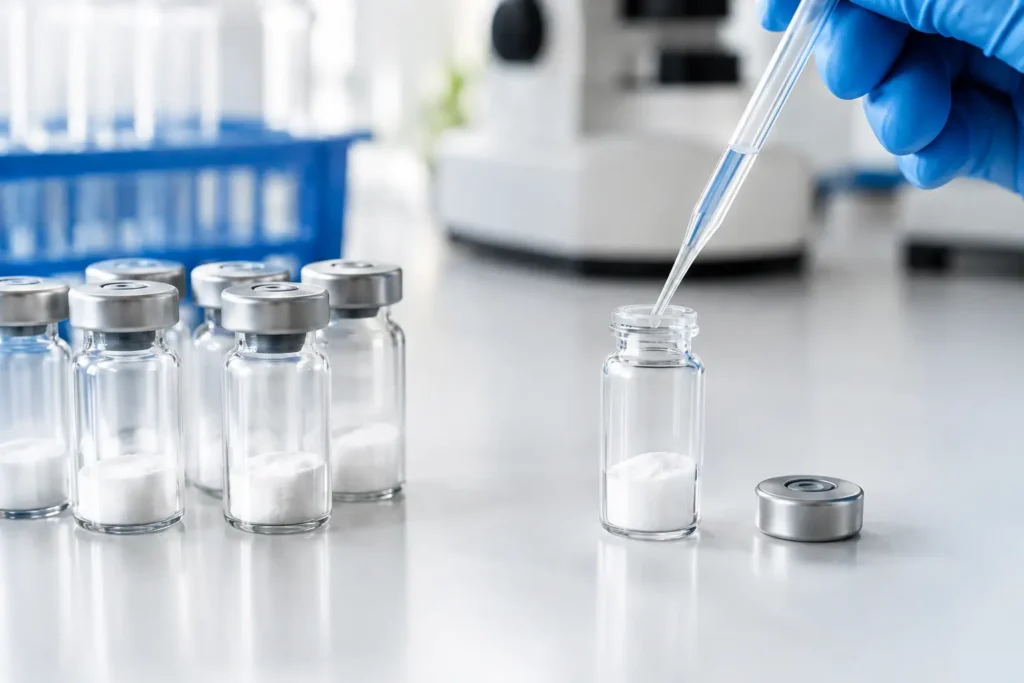
A lyophilized peptide vial is not ready for use simply because liquid has been added. Knowing how to reconstitute lyophilized peptides means controlling the variables that affect concentration, solubility, identity traceability, and downstream reproducibility. The reconstitution record should be treated as part of the experimental record, not as an informal bench note.
For research use only. Reconstitution conditions must be selected for the specific peptide, assay system, and approved laboratory protocol. These materials are not for human or veterinary use, diagnosis, treatment, or consumption.
Start With the Lot, Label, and COA
Before opening the vial, confirm that the label, lot number, stated peptide content, and certificate of analysis correspond. A purity value without a traceable lot number is not enough to support reproducible research. The COA should establish the released lot’s identity and analytical result, while the vial label establishes the material and quantity being handled at the bench.
Record the lot number, date received, storage condition, reconstitution date, selected solvent, final calculated concentration, and operator. If a study later produces an unexpected chromatogram, cell-response pattern, or stability result, these details provide the first path for determining whether the source is material handling, solution preparation, or the experimental system.
Inspect the vial before use. Lyophilized material may appear as a cake, film, powder, or residue, depending on peptide sequence, fill volume, and drying behavior. Appearance alone does not establish quality, but a damaged closure, evidence of moisture exposure, or a labeling discrepancy should be quarantined and investigated before the material enters a study.
Choose the Reconstitution Solvent From the Method
There is no universal solvent for every lyophilized peptide. The correct choice depends on amino-acid composition, charge state, hydrophobicity, intended concentration, target matrix, and the analytical or biological method that follows. A solvent that produces a clear initial solution may still be unsuitable if it interferes with a cellular assay, shifts pH outside the method’s acceptable range, or causes precipitation during dilution into the final matrix.
Start with the approved study method or the peptide-specific handling information available to your laboratory. Depending on the material and protocol, researchers may evaluate sterile water, buffered aqueous systems, dilute acid or base, saline-compatible solutions, or a limited percentage of an organic co-solvent. The goal is not to use the most aggressive solvent available. It is to use the least disruptive system that provides adequate dissolution and stability for the intended research application.
Consider what happens after the stock is made. A peptide dissolved in an acidic or organic-containing stock can precipitate when introduced into a neutral aqueous assay buffer. A concentrated stock can also carry enough vehicle into the final experiment to create a solvent effect. Calculate both the peptide concentration and the final concentration of every vehicle component in the assay.
When solubility is uncertain, use a small, documented pilot preparation rather than committing an entire vial to an unvalidated solvent system. Evaluate the solution under conditions relevant to the experiment, including the intended dilution matrix and hold time.
Calculate Concentration Before Adding Liquid
Set the target stock concentration before opening the vial. The basic relationship is:
Concentration = peptide mass / reconstitution volume
Rearranged for planning, the required volume equals the labeled peptide mass divided by the desired concentration. Keep units consistent. A 5 mg vial reconstituted with 1 mL of solvent produces a nominal 5 mg/mL stock. If the method is expressed in micromolar units, convert mass using the peptide’s molecular weight and document the basis for the calculation.
Avoid choosing a volume only because it is convenient to pipette. An overly concentrated stock may exceed the peptide’s practical solubility. An overly dilute stock can require large additions to the assay system, increase freeze-thaw exposure, and introduce avoidable vehicle volume. The appropriate concentration depends on the required working range, aliquot plan, and expected stability.
Use calibrated pipettes and a volume that can be delivered accurately. For very small volumes, the relative impact of pipetting error becomes substantial. If the method permits, preparing a slightly less concentrated primary stock with a more accurately measurable volume can be preferable to attempting a low-volume addition at the edge of pipette performance.
How to Reconstitute Lyophilized Peptides at the Bench
Allow a cold vial to equilibrate to room temperature while it remains sealed. This reduces the chance that atmospheric moisture condenses on the material when the closure is opened. Once equilibrated, disinfect the vial closure according to laboratory procedure and work using the aseptic controls appropriate to the intended application.
Add the calculated solvent volume slowly against the inside wall of the vial when practical, rather than directing a forceful stream into the dried peptide. This approach minimizes foaming and helps prevent material from being driven onto the stopper or vial neck. Confirm that all liquid has reached the vial interior and that none remains in the cap or on the closure.
Gently swirl or roll the vial until the material dissolves. Do not assume that vigorous vortexing is better. Mechanical agitation can introduce foam, complicate visual inspection, and may be unsuitable for peptides prone to aggregation or interface-related loss. Some materials require a defined equilibration period before they appear fully dissolved. Follow the established method rather than extending agitation or changing temperature without documentation.
Inspect the solution under suitable lighting. The expected appearance depends on the peptide and solvent, but visible particles, persistent haze, phase separation, or unexpected color warrant investigation. Do not filter, heat, sonicate, or alter pH as a reflexive troubleshooting step. Each intervention can affect recovery, concentration, chemical integrity, or assay compatibility. If an adjustment is necessary, record it as a method deviation or an evaluated procedure.
Protect the Stock From Avoidable Loss
Peptides can be affected by repeated temperature cycling, adsorption to containers, oxidation, hydrolysis, and concentration-dependent aggregation. The practical significance of each risk varies by sequence and solution conditions. A stable aqueous stock for one peptide may be a poor choice for another.
If the protocol supports freezing, divide the reconstituted stock into single-use or limited-use aliquots before storage. Aliquoting reduces the number of freeze-thaw cycles applied to the primary preparation and preserves a clearer chain of handling. Use container materials compatible with the method, especially where low-level recovery or adsorption is a concern.
Label every aliquot with the peptide identifier, lot number, concentration, solvent or buffer, preparation date, storage condition, and, where relevant, expiration or retest date established by the study. A tube labeled only with a short product name creates unnecessary ambiguity once it is separated from the original vial and COA.
Storage temperature and allowable hold time should come from peptide-specific data or a qualified internal stability plan. Do not convert a dry-vial storage recommendation into a blanket recommendation for a reconstituted solution. Lyophilized material and aqueous stock are different material states with different degradation pathways.
Verify What Matters for the Study
A clear solution is not analytical confirmation of intact peptide. For critical applications, especially quantitative work, long hold times, or studies sensitive to low-level degradation products, build an appropriate verification step into the method. Depending on the research question, this may include analytical HPLC, mass spectrometry, pH confirmation, concentration assessment, or a functional control defined by the assay.
Independent lot testing supports confidence in the released starting material. It does not replace controls for the solution prepared in a specific laboratory on a specific date. Wolf Peptides releases lots only after independent third-party testing, with documentation tied to the lot number, but downstream handling remains part of the researcher’s controlled process.
The most useful reconstitution practice is therefore not a universal solvent recipe. It is a documented decision: match the solvent and concentration to the method, preserve lot traceability, minimize unnecessary stress, and verify the preparation at the level the study requires. That discipline gives later results a defensible starting point.